A Cost-Effective, Low-Impact Remedial Approach for Metals: Utilizing Phyto-Enhancement to Accelerate pH Adjustment of Shallow Groundwater
ABSTRACT
This paper presents a unique, low-cost, low-impact approach to metals remediation in shallow groundwater at a former industrial site located in the Atlantic Coastal Plain. The approach employs pH adjustment of groundwater using agricultural lime coupled with the use of daikon radish to augment lime contact time and to increase depth of soil augmentation. This method is designed to be a more sustainable, less resource-intensive, and less technically challenging remedial alternative with lower estimated overall costs.
The primary corrective action (source removal) has been completed. However, the oxidation of residual sulfide-bearing minerals has resulted in persistent low-pH groundwater, which increases the solubility and mobility of metal constituents of interests (COIs). While long-term natural attenuation is expected, low-pH conditions could persist for decades; therefore, an evaluation of remedial options was completed to accelerate COI attenuation mechanisms.
The selected remedy is the application of agricultural lime (CaCO3) to the shallow subsurface to increase pH and buffering capacity in groundwater and unsaturated soil, thereby decreasing COI mobility and concentrations. Application dosage rates and details were developed after the baseline evaluation and analysis of subsurface soil conditions.
Although infiltrating rainwater will naturally carry the greater-pH water deeper into the water-bearing unit, SynTerra developed a simple, low-cost enhancement using daikon radish root channels (phyto-enhancement) to accelerate lime movement into the groundwater. This enhancement is expected to expedite the buffering capacity of the water-bearing unit and the time needed to decrease COI mobility. A robust monitoring well program is already established to track performance. The final assessment design, site characterization results, and lime application calculations are presented in this paper, along with initial observations from the novel pilot study.
INTRODUCTION AND PROJECT SITE CONTEXT
Remediation of metals in shallow groundwater remains a significant challenge for industrial sites, particularly those involving historical coal storage. This technical proceeding outlines a unique, low-cost, and sustainable remedial approach implemented at an industrial Site located in the Atlantic Coastal Plain.
The Site geology is characterized by unconsolidated sands, silts, and clays, with surficial groundwater encountered at a shallow depth of approximately 3 meters (m) [9.8 feet (ft)]. Groundwater flow is multi-directional with low hydraulic gradients, resulting in a flow velocity of approximately 8 m (26.2 ft) per year.
The study area (Site) was used for coal storage that supported industrial activities for more than 70 years. While the primary source removal was completed approximately 10 years ago, residual effects to the shallow subsurface persist. Specifically, metals concentrations in the groundwater are greater than state criteria, necessitating a corrective action plan to achieve compliance. The primary challenge identified pertains to the high solubility and mobility of metals driven by local geochemical conditions.
GEOCHEMICAL FRAMEWORK AND PROBLEM STATEMENT
The fundamental driver of metal concentrations in groundwater at the Site is the oxidation of residual sulfide minerals or sulfide-bearing materials. During the 70-year period when the source material was stored at the Site, sulfide mineral phases accumulated in the underlying soils. Oxidization of those sulfide mineral phases, or sulfide-bearing materials, occurred during source material storage. This condition persists post source removal, and the continued infiltration of precipitation has facilitated the oxidation of those minerals, resulting in persistent low-pH conditions within the soil and groundwater. In these acidic conditions, the solubility of the metal constituents of interest (COIs) increases significantly, facilitating and accelerating transport in shallow groundwater.
While long-term natural attenuation is anticipated via the eventual flushing of sulfide-bearing materials by circumneutral upgradient groundwater and rainwater, geochemical modeling indicates that without intervention, these low-pH conditions and elevated metals concentrations in groundwater could persist for centuries. The remedial objective is to accelerate natural attenuation mechanisms by increasing the subsurface soil pH and buffering capacity, thereby neutralizing the groundwater and decreasing COI mobility. To support existing natural attenuation processes, as well as the completed source removal, the selected remedy involves applying agricultural lime (CaCO3) to the shallow subsurface as a “polishing” measure.
REMEDIAL DESIGN AND SOIL CHARACTERIZATION
High-density soil sampling was conducted to develop an effective dosing strategy. Sixteen direct-push soil borings were advanced to a depth of 3 m (9.8 ft) below ground surface (bgs), with a particular focus on the 2.4-m (8-ft) unsaturated zone above the groundwater table. Soil samples were collected at 0.61-m (2-ft) intervals to characterize vertical variations in soil chemistry.
The Clemson University Agricultural Services Laboratory analyzed the samples for parameters including soil pH, buffer pH, cation exchange capacity, and percent base saturation; those results revealed significant spatial and vertical heterogeneity:
- Western Area: characterized by highly acidic conditions, with soil pH ranging from 2.9 to 4.1 standard units (S.U.)
- Eastern Area: exhibited less acidic conditions, with soil pH ranging from 4.0 to 6.9 S.U.
LIME DOSAGE METHODOLOGY AND APPLICATION PRECISION
Standard agricultural lime dosing calculations are typically designed to adjust the top 20 centimeters (cm) (8 inches) of soil (typical food crop root zone) to a pH of approximately 6.0 S.U. for crop health. This remedial approach required a specialized adaptation of those calculations in collaboration with Clemson University agronomists to address industrial remediation requirements.
CALCULATION ADJUSTMENTS
The dosing strategy incorporated three primary technical adjustments:
- Target pH elevation: The target pH was set to 7.0 S.U. to provide sufficient buffering against ongoing sulfide oxidation and to maximize COI immobilization.
- Regression analysis: Because the Site pH was frequently less than the standard agricultural calculator’s lower limit of 4.4 S.U., natural log regressions were used to extrapolate lime requirements based on known buffer pH relationships.
- Volume scaling: The dosage was scaled from the standard 20-cm (8-inch) agricultural depth to treat the full 2.44-m (8-ft) unsaturated column.
PRECISION APPLICATION
The resulting calculation indicated a total lime requirement of approximately 81.65 metric tons (90 tons) across an 8,900-square-meter (2.2-acre) treatment area. A phased application approach was designed to prevent surface “crusting” (i.e., pozzolanic reactions similar to lime-soil stabilization processes where lime acts as a cementing agent to transform soft soils into a dense cement-like surface layer that could impede rainwater infiltration). Approximately 81.65 metric tons (90 tons) of lime are being applied in four small doses, with incubation between lime applications to allow a more complete reaction of the lime with the soils.
Precision agriculture tools are used for lime applications. Variable-rate spreaders, guided by the Global Positioning System (GPS) and geofencing, are used to match the specific lime dosage to the identified pH requirements of each grid cell. Doses are applied at their calculated dosing rates with a 10-week incubation period between applications. After application, the lime was tilled into the soil to a depth of approximately 46 cm (18 inches) to facilitate contact.
PHYTO-ENHANCEMENT: THE BIOLOGICAL DRILL CONCEPT
While mechanical tillage accesses the top layer of soil, the effectiveness of lime at depth (1.22 m [4 ft] bgs to 2.44 m [8 ft] bgs) is dependent on slower infiltration through soil matrix. To accelerate this vertical transport, the project team implemented a novel phyto-enhancement strategy using Raphanus sativus, specifically the “Driller Daikon” from Grassland Oregon Seed.
MECHANISM
Unlike traditional phytoremediation, which often relies on plants to extract or degrade constituents, this approach uses the plant’s physical growth to modify soil hydraulic properties. The daikon produces a large taproot capable of exerting up to 2,000 kilopascals (290 pounds per square inch) of pressure to penetrate compacted or heavy clay soils. Those roots reach depths of 0.91 m (3 ft) to 1.52 m (5 ft) and can grow to diameters of up to 10 cm (4 inches).
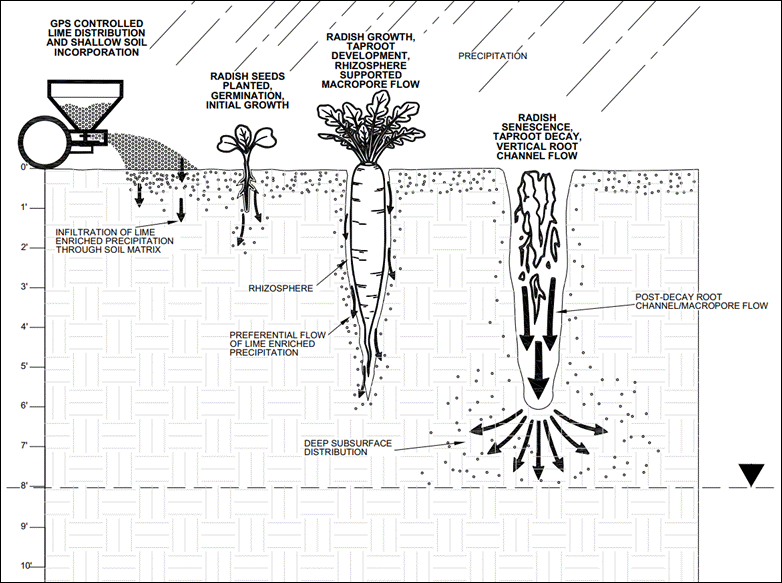
As the roots develop and eventually decompose, macropores (i.e., large, stable root channels that serve as preferential flow pathways) are created. Those pathways allow lime-enhanced rainwater to bypass the slow, matrix-dominated flow of the upper soil layers and move rapidly into the deeper subsurface. This is illustrated in Figure 1 below. Research indicates that daikon radishes can reduce stormwater runoff by up to 45 percent, significantly increasing the volume of clean, buffered water recharging the shallow aquifer.
ADVANTAGES OVER TRADITIONAL PHYTO-EXTRACTION
The phyto-enhancement approach offers these advantages:
- Non-extractive: There is no requirement to harvest, transport, or dispose of metal-concentrated biomass because the plants are used for structural advantages rather than chemical removal.
- Rapid development: Unlike tree-based phytoremediation systems that may require years to establish, daikon radishes grow rapidly and begin creating macropores within a single growing season.
- Sustainability: The seeds are cost-competitive with standard erosion control mixes, providing additional remedial benefits with negligible incremental costs.
INITIAL PILOT STUDY OBSERVATIONS
The implementation of the phyto-enhancement pilot study began after the second lime application. Initial performance monitoring has provided preliminary data; however, Site conditions have been affected by a regional severe drought.
SOIL PROFILE RESPONSE
Monitoring of soil pH at various depth intervals after the first dosing phase showed promising results:
- Zero to 0.61 m (0 to 2 ft) bgs interval: significant improvement, attributed to direct mechanical tillage and high soil-lime contact
- 0.61 to 1.22 m (2 to 4 ft) bgs interval: moderate improvement, though results were more variable
- 1.22 to 1.83 m (4 to 6 ft) bgs interval: least improvement, confirming that vertical transport is the primary limiting factor in the remedial timeline
The drought conditions have limited the precipitation-driven movement of lime through the newly created daikon macropores. However, the establishment of the initial radish crop, as well as follow-up radish plantings, maintains the operation of a preferential flow system once normal precipitation patterns return.
FUTURE OPTIMIZATION: THE BIOLOGICAL CAP
After the completion of the planned lime applications and several seasons of daikon growth, the Site will transition to a long-term maintenance phase. The proposed strategy involves the use of annual ryegrass (Lolium multiflorum) as a biological cap. Some varieties of annual ryegrass have the capacity to increase soil pH and provide ongoing buffering through root exudates. While traditionally used to optimize soil for corn production, this method is being repurposed in this remedial strategy to maintain a circumneutral pH in industrial subsoils. The biological cap will provide a self-sustaining mechanism to prevent the re-acidification of soils and provide continuous erosion control with minimal maintenance requirements.
PERFORMANCE MONITORING AND REGULATORY INTEGRATION
A robust groundwater monitoring network is used to track the pH and COI responses. Data are collected under an effectiveness monitoring plan and submitted in annual reports. The remedy is subject to 6-year reviews, which will include updated Mann-Kendall trend analyses to assess whether the accelerated attenuation is meeting model predictions.
If the 6-year review indicates that the strategy is insufficient, a contingency plan is in place to evaluate more aggressive remedial technologies, such as deep soil mixing or expanded application areas. However, the current approach is designed to be adaptable, with annual evaluations used to determine the necessity and dosage of subsequent lime applications.
CONCLUSION
The remedial strategy implemented at the Site aligns precision agricultural techniques with the biological capabilities of Raphanus sativus to circumvent energy-intensive, highly engineered remedial systems. The strategy enhances existing natural attenuation mechanisms to provide a low-cost polishing remedy that accelerates the remedial timeline of natural attenuation alone. The remedy addresses the fundamental geochemical factors of metal mobility (i.e., low soil pH and sulfide oxidation) at a fraction of the cost of conventional remedial techniques by approaching the concern in a manner that is consistent with the natural attenuation mechanisms already at work in the system.
The preliminary results show that while mechanical application and tillage provide immediate results in the upper soil horizons, the long-term success of the remedy at depth relies on the development of a network of deep preferential flow pathways provided by daikon. The daikon radishes serve as a low-impact biological tool to bypass soil matrix limitations, facilitating the vertical transport of buffered recharge to the shallow aquifer.
Despite the challenges posed by severe drought, the establishment of the phyto-enhancement system will maximize the remedial benefits of future precipitation events. The future transition to a biological cap using annual ryegrass will provide a self-sustaining, low-maintenance buffering mechanism for long-term compliance. This approach demonstrates that leveraging existing agricultural technologies, agronomic science, and biological “bio-drilling” offers a scalable, sustainable, and technically sound path toward regulatory closure for large-scale industrial sites with adversely affected shallow groundwater.
REFERENCES
[1] G. Chen and R. R. Weil, “Penetration of cover crop roots through compacted soils,” Plant Soil, vol. 331, no. 1–2, pp. 31–43, Jun. 2010, doi: 10.1007/s11104-009-0223-7.
[2] M. Baerg, “Tillage radishes – a new option for improved soil health,” Top Crop Manager, Agronomy Tillage, Dec. 10, 2013. [Online]. Available: https://www.topcropmanager.com/tillage-radishes-a-new-option-for-improved-soil-health-14543/
[3] S. M. Williams and R. R. Weil, “Crop cover root channels may alleviate soil compaction effects on soybean crop,” Soil Sci. Soc. Amer. J., vol. 68, no. 4, pp. 1403–1409, Jul. 2004, doi: 10.2136/sssaj2004.1403.
[4] K. Elmy, “Three uses for forage radish,” Grainews, [Online]. Available: https://www.grainews.ca/features/three-uses-for-forage-radish/
[5] “Daikon radish as a cover crop: Dakota erosion control & soil health for 2026 and beyond,” Farmonaut, 2026. [Online]. Available: https://farmonaut.com/usa/daikon-radish-as-cover-crop-dakota-erosion-control
[6] S. Cappellazzi, “Root characteristics of cover crops under restrictive soil conditions,” presented at the Tri-Societies Meeting, Baltimore, MD, USA, Nov. 8, 2022.